Jo-Anne M. Hernandez
Teaching Portfolio
DOMAIN B: THE ACT OF TEACHING
B1. Teaching Assistants will demonstrate competency in engaging all learners in English language communication and cultural understanding using language acquisition teaching strategies, includ-ing applications of multi-media technologies.
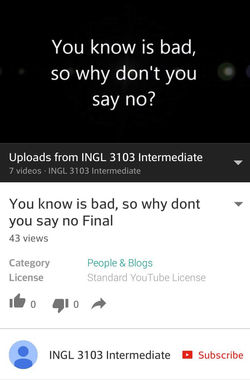
One of the concerns regarding the teaching of Intermediate English I, during both occasions, which I was able to teach this course, was that other than activities and in class discussions, students did not have additional opportunities to communicate and express themselves, both amongst each other and in front of an audience. For this reason, when planning each essay, which covered writing goals, I also incorporated an additional activity to accompany each essay, where they had the opportunity to express themselves in front of an audience, demonstrating communication skills in the English language. For the first essay, which was reflective essay, students had to prepare a mini speech based upon their reflective papers, to in a way introduce themselves through their reflective essays, in order for their class mates to get to know them better. For the informative essay, which was a more objective essay, they had to prepare an informative power point presentation where they would include the main points of their informative essay. Students would then give this presentation in front of their classmates. This provided an opportunity for formal presentations in class. For the third essay, the argument essay, students had to also participate in a formal in class debate and prepare for this debate outside of class as homework. The in class debate demonstrates to students the importance of using evidence and being able to develop counter arguments. This debate also gives students the opportunity to communicate amongst each other in a more formal manner in class. Students must address each other in English and present their supporting evidence in an organized manner. Another beneficial aspect of this debate is that students practice their English language fluency, as they develop counter arguments for the evidence presented at the moment it is presented with the use of evidence. The last essay, rhetorical analysis is both an essay and an opportunity to put in practice the use of ethos, pathos and logos because students create a public service announcement video using ethos, pathos and logos. These elements are learned in class as part of the rhetorical analysis essay unit. Students are able to communicate in the English language during the creation and recording of the video, as well as present, although in a recorded manner, in front of an audience. These additional projects help students develop, not just as writers of the English language but also as speakers of this language. This procedure of teaching writing and speaking, as well as listening and reading is part of a balanced instruction in the English language, and is present in the curricular maps for English teaching instruction of the Department of Education. These maps detail what students need to know in each grade and the mayor areas which need to be covered, these being listening, speaking, reading writing, and language development, all of which I attempt to cover in each of my classes, units and courses.
B2. Teaching Assistants will manage typical classroom procedures.
One of the most essential aspects of teaching, which I learned during my teaching preparation, was the importance of handling classroom procedures. In our teaching practice we created a plan for every class, were we detailed every aspect of teaching, from content to classroom procedures. We specified our initial, development and closing activities as well as the main goals of each class. Thanks to this experience, when I began teaching my first two sections of Intermediate English I, I was able to distribute classroom time effectively. Each class was divided, similar to the practice, in initial, development and closing activities. In my initial activities, I would greet students, take attendance as well as give them the attendance sheet to sign, as evidence that they were indeed present on that day. During this time, I would also collect or hand back home works and give a review of the class given before to refresh students’ minds of what they had been previously taught. On my development activities I introduce or continue discussing theory and finally at the time assigned for closing activities, students are given the opportunity to practice applying what they learn as well as receive clarification of their most pressing doubts and concerns. It is important to manage these procedures in class and always have a routine for these procedures, even if the content of the activities is different for each unit and class, to help students maintain an order when learning. In my opinion, organized classes are the most effective classes, as the teacher is prepared and is able to manage time effectively to deliver proper instruction.
B3. Teaching Assistants will communicate effectively using verbal, nonverbal, and media communi-cation techniques.
In my courses for the teaching certification, I had to do a pre and posttest unit, where I evaluated what students knew about the material and analyzed the results to plan according to the knowledge they did not posses. Once I taught the unit based on the results, I gave a posttest to verify if what I taught was effective or not. Finally, the last step for this unit was to evaluate those results and re-teach what students did not dominate after the unit. This revealed to me the importance of verifying students’ comprehension of the material and the necessity to re-teach if they did not fully comprehend what was instructed. In the case of the college level students of my Intermediate English I and II classes, who are assigned essays, not tests, I was constantly aware of the main goals of the course. The goals, which I stressed importance of in my class, were that students learn the steps of the writing process, the creation of adequate thesis statements, the structure of essays as well as the use of MLA, proper citation methods and evidence use. For each of the essays taught, when correcting, I would write down the most common errors presented by many of the students. Based upon this, I would take a day of class to discuss the errors and teach how to fix these errors in future papers. As the semester progressed, and I adjusted my calendar to include those error correction classes, the margin of student error in essays decreased significantly. It is very important to be aware of student errors and take time to correct them, not just on their essays, which they might never look at again, but in the classroom, where students are able to clarify doubts concerning to the reasons why the committed such errors. Repetition is a very important element as well because many students require the material to be taught in more than one class period to learn it properly, using exercises and practice to achieve this.
 |
|---|
 |
 |
 |
 |
 |
 |
 |